• Skip to main content
  • Skip to after header navigation
  • Skip to site footer
dope new mexico

Dope New Mexico

cannabis news and dope stuff in new mexico

  • Home
  • Dispensary Near Me
  • News
  • Search page
Uncategorized

“Diet weed”: What is it and why experts warn it could be dangerous

November 11, 2023 by Michael Bartiromo

(NEXSTAR) – Should we be wary of “diet weed”?

Delta-8 tetrahydrocannabinol (Delta-8-THC) is one of many cannabinoids found in the cannabis sativa plant, though it isn’t naturally produced at the same rate or potency as Delta-9-THC, the compound largely responsible for marijuana’s psychoactive effects.

“Chemically, they’re almost identical. But that one little difference in that chemical structure results in a different way that it interacts with your body … with your [cannabinoid] receptors,” explains Ryan Vandrey, Ph.D., a professor at the Johns Hopkins School of Medicine who specializes in the behavior pharmacology of cannabis.

“The reason people call Delta-8-THC ‘diet weed’ [is because] that chemical difference is a little less potent at what it does at the receptor,” Vandrey said, telling Nexstar that Delta-8 is “about half as effective” at producing the same effects as Delta-9.

Marijuana use increases risk of heart attacks, new studies suggest

Still, Delta-8-THC has experienced a boom in popularity in recent years, largely thanks to the 2018 farm bill which, when enacted, inadvertently paved the way for the Ninth Circuit Court to rule that certain low-THC cannabis derivatives were exempt from the Controlled Substances Act.

The Food and Drug Administration, in recent years, has publicly taken issue with the unregulated status of Delta-8 and similar cannabinoid derivatives, noting that Delta-8 still has “psychoactive and intoxicating effects that may be dangerous to consumers” and urging Congress to establish regulations. These hemp-derived cannabinoids are also often chemically synthesized, allowing for the potential of harmful contaminants, the FDA argues.

Making matters murkier, the U.S. Drug Enforcement Administration (DEA) continues to maintain that non-naturally occurring cannabinoids (i.e., chemically derived versions) are controlled substances, despite the Ninth Circuit Court’s 2022 ruling.

Some lawmakers are currently working to close the loophole that allowed Delta-8 to become legal on a federal level. But in the meantime, many states have set their own regulations concerning the legality of hemp-derived products — a move which may only further confuse things, according to experts.

“In addition to lack of regulation, we have regulatory incoherence from different branches and levels of government. … That’s going to make it even harder to get any coherent regulation on things,” Peter Grinspoon, M.D., a primary care doctor and cannabis specialist at Mass General Hospital and an instructor at Harvard Medical School, tells Nexstar.

Grinspoon, also the author of “Seeing Through the Smoke: A Cannabis Specialist Untangles the Truth About Marijuana,” is himself a proponent of legalized recreational marijuana. But even he feels there needs to be and oversight to make sure it’s being regulated to restrict who has access to it, and to prevent contaminants, which can include heavy metals, pesticides or other harmful substances.

“Delta-8 is so close to Delta-9, it’s probably relatively safe,” Grinspoon says. “But even if we figured out that Delta-8 is safe — the Delta-8 you’re buying at your local smoke shop, we have no idea what’s in it.”

Vandrey also opened the possibility that some readily available Delta-8 THC products may be substituting other cannabinoids aside from Delta-8, or other drugs entirely.

“The main harm in all of this is that the industry has been allowed to exist and flourish with no regulatory control. The result is poor product control, poor dosage label accuracy, and contaminated products are widely available,” Vandrey says.

“There are individual companies and entities that are probably doing a good job [of their own quality control], but most certainly there are companies or entities that are not,” he added.“It’s very concerning.”

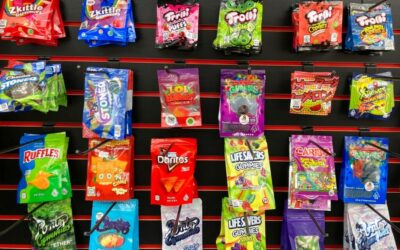
An array of products advertised as containing synthetically derived Delta-8 THC is offered for sale at a smoke shop in north Seattle on Friday, Feb. 25, 2022. (AP Photo/Gene Johnson)

The FDA, over the last year, has similarly warned of the possibility that “unsafe” chemicals may be used to chemically synthesize or dye Delta-8 products. But Delta-8 itself may cause serious adverse effects on its own, the agency says.

Between Dec. 2020 and March 2022, the FDA said it was made aware of 104 cases of adverse effects including “hallucinations, vomiting, tremor, anxiety, dizziness, confusion, and loss of consciousness,” over half of which required medical evaluation. During a similar time frame, national poison control centers reported thousands of cases of exposure, including one pediatric case that was “coded with a medical outcome of death,” the FDA wrote.

In 2023, the FDA and the Federal Trade Commission (FTC) also warned a half-dozen companies to stop selling Delta-8-THC products in packaging that resembled snack foods.

“Children are more vulnerable than adults to the effects of THC, with many who have been sickened and even hospitalized after eating ‘edibles’ containing it,” wrote FDA Principal Deputy Commissioner Janet Woodcock, M.D. 

Woodcock also said adults, too, were at risk of “serious” consequences when taking THC products in high doses.

Vandrey, who has observed Delta-8’s effects in human laboratory experiments at Johns Hopkins, said that people diagnosed with psychosis, schizophrenia, bipolar disorder and cardiovascular disease, among other conditions, are at higher risk of “very severe reactions” from taking Delta-8 THC products. And having a nickname like “diet weed” (or “cannabis lite,” as Grinspoon has heard) doesn’t do much to warn users of its potentially adverse effects, Vandrey adds.

“When you have connotations that it’s ‘diet weed,’ and you can buy it at the gas station, you think, ‘How can it be harmful?’” he says. “A lot of folks don’t understand you can get a very strong psychoactive effect, and become very impaired and very intoxicated using these products.”

You can’t trash or recycle them. So how do you safely get rid of disposable e-cigarettes?

To prevent any further harm to users, Vandrey believes the government — including the FDA and DEA — should work toward clearing up any gray areas of legality concerning Delta-8-THC. And if it is legal, to start regulating it like everything else.

The other solution, as hinted at by both Vandrey and Grinspoon, is the federal legalization of Delta-9 THC — which is already legalized and regulated in many states — as they believe it would tank the market for unregulated Delta-8 THC products.

“What the science tells us is … it’s really just a potency difference [between Delta-8 and Delta-9 THCs],” Vandrey says. “Knowing that, it makes no sense to have one be a Schedule 1 drug and one be unscheduled and unregulated.”

“This is like the wild west,” Grinspoon adds. “It needs regulation.”

(NEXSTAR ) – Should We Be Wary of “Diet Weed”?

Delta-8-THC is one of the many cannabinoids that are found in cannabis sativa plants. It is not produced as naturally or with the same potency as Delta-9 THC, which is the compound responsible for the psychoactive effects of marijuana.

Chemically, they are almost identical. This one small difference in chemical structure affects the way it interacts with the body, and with the [cannabinoid]-receptors, explains Ryan Vandrey Ph.D.

Vandrey told Nexstar that Delta-8 was “about half as potent” as Delta-9 at producing the same effect.

New studies show that marijuana use can increase the risk of heart attack

Delta-8-THC is still gaining popularity, thanks in part to the 2018 Farm Bill, which was enacted inadvertently and paved the path for the Ninth Circuit Court ruling that certain low THC cannabis derivatives are exempt from Controlled Substances Act.

In recent years, the Food and Drug Administration has publicly expressed its concern about the unregulated status for Delta-8 and other cannabinoid products. They noted that Delta-8 has “psychoactive and euphoric effects which may be harmful to consumers” and encouraged Congress establish regulations. The FDA also argues that these hemp-derived cannabinoids may be chemically synthesized and therefore contain harmful contaminants.

The U.S. Drug Enforcement Administration continues to maintain, despite the 2022 ruling of the Ninth Circuit Court, that chemically derived cannabinoids are substances that should be controlled.

Some legislators are working to close the loophole which allowed Delta-8 to be legalized on a federal basis. In the meantime, however, many states have enacted their own laws governing the legality and use of hemp-derived products. This, say experts, could only cause confusion.

“Regulatory incoherence is a problem that we face, along with the lack of regulations from all levels and branches of government.” This will make it harder to come up with a coherent regulatory framework, says Peter Grinspoon M.D.

Grinspoon is a supporter of recreational marijuana legalization. He’s also the author “Seeing Through The Smoke: A Cannabis Expert Untangles Marijuana Truth.” Even he believes there should be a regulatory system to limit who can access it and to avoid contaminants such as heavy metals, pesticides and other harmful substances.

Grinspoon says that because Delta-8 is close to Delta-9 it’s likely relatively safe. “But even if it was proven that Delta-8 is safe, the Delta-8 sold in your local smoke shops has no indication of what’s inside.”

Vandrey has also suggested that Delta-8 THC may be substituted for other cannabinoids or drugs.

The main harm is that there has been no regulatory control over the industry. Vandrey says that the result is poor quality control and inaccurate dosage labels. Contaminated products are also widely available.

He added: “There are some companies and organizations that do a great job in terms of quality control, but there are others that don’t.”

It’s very worrying.


A smoke shop in North Seattle, on Friday February 25, 2022, is selling a variety of products that are advertised as having synthetic Delta-8 THC. (AP Photo/Gene Johnson)

In the past year, the FDA has warned that it is possible to use “unsafe” chemicals in the chemical synthesis or dyeing of Delta-8 products. The FDA warns that Delta-8 may have serious side effects by itself.

The FDA reported that between Dec. 2020 to March 2022 it had been made aware of 104 adverse reactions, including “hallucinations,” vomiting, tremors, anxiety, confusion, and a loss of consciousness. Over half of these cases required medical evaluation. The FDA reported that during the same time period, thousands of cases were reported by national poison control centres, including one case in which “a medical outcome was death” .

The FDA, and the Federal Trade Commission warned in 2023 that they would not sell Delta-8-THC-containing products packaged to look like snack foods.

Janet Woodcock M.D., FDA’s Principal Deputy Commissioner, wrote that “Children have a greater vulnerability to THC’s effects than adults.”

Woodcock said that adults are also at risk for “serious” side effects when they take THC products.

Vandrey has observed Delta-8’s effects on humans in laboratory experiments at Johns Hopkins. He said that people with conditions such as schizophrenia, bipolar disorders, psychosis and cardiovascular diseases are more likely to experience “very severe reactions” when taking Delta-8 THC. Vandrey says that a name like “diet marijuana” (or “cannabis light,” as Grinspoon heard) does not do much to warn consumers of the potential adverse effects.

He says that when you hear the term ‘diet marijuana’ and know you can purchase it at a gas station, it makes you wonder if it is harmful. Many people don’t realize that these products can have a strong psychoactive effect and cause you to become intoxicated and impaired.

They can’t be recycled or thrown away. How can you safely dispose of disposable e cigarettes?

Vandrey says that the FDA, DEA and other government agencies should do their best to clear up any legal gray areas surrounding Delta-8-THC. If it’s legal, then regulate it as you would everything else.

Vandrey and Grinspoon both suggested that the other solution is to legalize Delta-9 THC federally, which is already legalized in many states. They believe this would destroy the market for Delta-8 THC unregulated products.

Vandrey says, “What the science shows us is that it’s just a difference in potency [between Delta-8 THCs and Delta-9]”. “Knowing this, it doesn’t make sense for one to be a Schedule I drug and another unscheduled or unregulated.”

Grinspoon continues, “This is the Wild West.” “It’s a wild west.” Grinspoon adds.

Michael Bartiromo
Author: Michael Bartiromo

About Michael Bartiromo

Previous Post:Texas Marijuana Reform Group examines the impact of similar measures in five other cities before voting on decriminalization in Lubbock
Next Post:Bipartisan Wisconsin Lawmakers File a Bill to Create a Psilocybin Pilot Program for Military Veterans with PTSD

Terms and Conditions - Privacy Policy